

Every year, thousands of Australians search Google for a doctor, a physio, a dentist, or a specialist. They type in a symptom, a suburb, or a service, and within seconds they are looking at a shortlist of providers. For healthcare businesses, that moment is everything.
Google Ads puts your clinic or practice at the top of those results. Done well, it brings in a steady stream of patients who are already looking for what you offer. Done poorly, it burns through budget without producing bookings, or worse, lands your business in trouble with AHPRA or the TGA for non-compliant ad copy.
The difference between those two outcomes usually comes down to one decision: which agency you choose to manage your campaigns.
Healthcare advertising carries regulatory obligations, audience sensitivities, and conversion dynamics that many agencies are simply not equipped to handle. A campaign built without knowledge of AHPRA’s advertising guidelines can expose a registered practitioner to a formal complaint before a single appointment is booked.
This guide is written for healthcare business owners, practice managers, and marketing leads who are considering hiring a Google Ads agency in Australia. It covers what to look for, what to avoid, the right questions to ask, and how to make a confident, informed decision.
Why Healthcare Google Ads Is a Specialist Field
Healthcare advertising on Google operates under a layer of regulatory and platform-level constraints that do not apply to most other industries. Understanding those constraints and knowing how to work within them is what separates an agency with genuine healthcare capability from one that will create problems for your business.
At the platform level, Google restricts certain categories of healthcare advertising and requires certification for others, including ads for prescription medicines and certain clinical services. Beyond Google’s own policies, Australian healthcare practitioners must comply with AHPRA’s advertising guidelines under the Health Practitioner Regulation National Law, which prohibit testimonials, comparative claims, and any language that implies guaranteed treatment outcomes. Advertisers promoting therapeutic goods must also adhere to TGA regulations. These rules apply to the entire advertising chain, headlines, descriptions, extensions, and landing pages, not just the ad itself.
The practitioner carries personal liability for non-compliant advertising, regardless of whether an agency placed it on their behalf. That distinction matters when choosing who you trust with your account.

Types of Healthcare Providers That Need Google Ads
Google Ads can be an effective patient acquisition channel across a wide range of healthcare settings, including:
- Private practices (GPs, specialists, and allied health providers)
- Dental and cosmetic clinics
- Mental health and psychology services
- Physiotherapy, chiropractic, and podiatry clinics
- Telehealth platforms
- Medical device and health product retailers
- Hospitals and day surgeries
Each of these has its own compliance considerations, keyword landscape, and patient decision-making journey. An agency with genuine healthcare experience will understand those differences rather than applying a generic campaign template across all of them.
What to Look for in a Healthcare Google Ads Agency
Proven Healthcare Experience
Ask any prospective agency for case studies or examples from the healthcare sector specifically. Look for evidence that they understand how patients search, how healthcare conversion funnels behave, and how to structure campaigns around appointment intent rather than just traffic volume.
Experience in other industries does not transfer automatically to healthcare. The keyword environment, the compliance requirements, and the way patients evaluate providers before booking are all distinct from other sectors.
Knowledge of Australian Healthcare Compliance
Any agency managing healthcare campaigns in Australia should have a working knowledge of:
- AHPRA advertising guidelines, including restrictions on testimonials, comparative claims, and outcome guarantees
- TGA regulations for campaigns promoting therapeutic goods or devices
- Privacy Act obligations around the handling of health-related data
- Google’s own healthcare advertising policies and restricted category requirements
Compliance knowledge should be demonstrated, not just claimed. Ask how the agency handles AHPRA-restricted language in ad copy, and whether they review landing pages as part of their compliance process.
Google Ads Certifications and Partner Status
Google Partner and Premier Partner status indicates that an agency meets minimum thresholds for certification, managed spend, and account performance. These are not guarantees of quality, but they are useful baseline indicators. Ask about the certifications held by the people who will actually manage your account, not just the agency as a whole.
Transparent Reporting and Account Ownership
A reputable agency will give you direct access to your own Google Ads account and report on metrics that are meaningful for healthcare, such as cost per booking, cost per call, and patient enquiry volume, rather than vanity metrics like impressions or click-through rate.
Account ownership is a critical point. Your Google Ads account, including all historical data, should be held in your name. Agencies that insist on retaining account ownership create a dependency that puts you at a disadvantage if you ever need to change providers.
Conversion Tracking and Booking System Integration
Accurate conversion tracking is the foundation of any well-run Google Ads account. For healthcare practices, this is more technically complex than it sounds.
Many clinics use third-party booking platforms such as Cliniko, HotDoc, or Power Diary. These systems are hosted on separate domains, which means standard Google Ads conversion tracking cannot attribute completed bookings without a custom cross-domain implementation. Without it, reported conversion data will be unreliable, and any optimisation decisions made on that data will amount to guesswork.
Ask any prospective agency how they track conversions for practices using your specific booking platform, and what their process is for validating that tracking before they begin optimising.
Local and National Campaign Experience
Whether you operate a single-location clinic or a multi-site network, the agency you choose should have experience with the geographic scope your campaigns require. Local campaigns for individual practices demand granular suburb-level targeting and a strong understanding of how patients in specific areas search and decide. Multi-location networks require campaign architecture that can manage budget and performance consistently across sites without cannibalising between them.
Red Flags to Watch Out For
Certain agency behaviours are worth treating as immediate warnings.
Guarantees on rankings or lead volumes. No agency can guarantee a specific position in Google Ads results or a fixed number of monthly leads. Paid search is an auction environment with too many variables for those commitments to be meaningful.
No evident knowledge of AHPRA or TGA requirements. If an agency cannot speak to Australian healthcare advertising compliance in specific terms, they are not well-placed to manage regulated healthcare campaigns.
Lock-in contracts without performance benchmarks. Long contract terms are not inherently problematic, but they should be paired with clear performance expectations and defined review points.
Account ownership retained by the agency. Your account data belongs to your business. Any arrangement where the agency holds account ownership puts your historical data and campaign continuity at risk.
Reporting that does not reflect healthcare KPIs. If an agency’s reports lead with impressions and traffic without connecting activity to actual patient enquiries, they are measuring the wrong things.
Questions to Ask a Potential Agency
Before committing to any agency, work through these in a discovery or proposal meeting:
- Can you share examples of healthcare clients you have worked with and what results you achieved?
- How do you approach AHPRA compliance in ad copy and landing page content?
- Who holds ownership of the Google Ads account?
- How do you track phone call and booking conversions, and how do you handle practices using third-party booking platforms?
- What does your onboarding process look like, and how long before campaigns are live?
- How do you handle a campaign that is underperforming against agreed benchmarks?
What a Capable Agency Looks Like in Practice
Understanding the theory of what to look for is useful. Seeing how it plays out in a real account is more useful still.
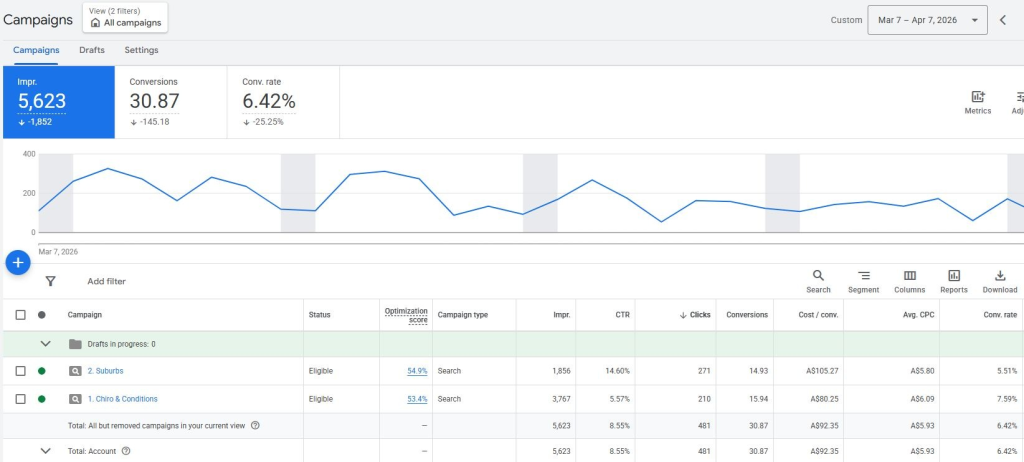
A Perth-based chiropractic practice came to Pitch Black in early 2026 having run Google Ads for some time without any conversion tracking in place. Spend was going out and clicks were coming in, but there was no way to attribute bookings, calls, or form submissions to specific campaigns. Budget allocation had been driven entirely by assumption.
The second issue was more serious. The existing ad copy contained language that violated AHPRA advertising guidelines under Section 133 of the Health Practitioner Regulation National Law, including comparative claims implying superiority over other practitioners and language suggesting guaranteed treatment outcomes. The practitioner carried personal liability for that content regardless of who had written it.
Pitch Black paused the non-compliant ads and rewrote all copy to meet AHPRA’s advertising obligations before doing anything else. Compliance came first, ahead of any performance work.
The tracking problem required a custom solution. The practice used Cliniko as their booking platform, which is hosted on a separate domain. Standard Google Ads conversion tracking cannot follow a user through to a completed booking in that environment. Pitch Black configured cross-domain conversion tracking via Google Tag Manager, passing the Google Ads click ID through the Cliniko booking flow to attribute real booking intent back to specific ad clicks.
The results across three tracked periods tell the story clearly. In the initial period, with only a button click proxy in place, the account reported a 30% conversion rate, a figure that reflected clicks on a booking button, not actual appointments. Once real cross-domain tracking was live, the conversion rate settled at 6.42%, the first accurate read of what the campaigns were actually producing. After a month of optimisation with reliable data, the conversion rate climbed to 11.96% and cost per conversion fell by 35%. Accounting for an estimated 25% attribution gap still present in the Cliniko booking flow, the true conversion rate was approximately 15%.
The improvement came from building measurement correctly, addressing compliance at the outset, and then optimising with data that could actually be trusted.
Why Pitch Black
Pitch Black is a Perth-based Google Ads and SEO agency that works across a range of industries, with a well-developed approach to regulated and compliance-sensitive verticals, including healthcare. For practitioners advertising under AHPRA or TGA obligations, the agency builds compliance review into every account it manages, covering ad copy, extensions, and landing page content. This is treated as a prerequisite for any campaign going live, not an afterthought.
On the measurement side, Pitch Black has developed experience with the cross-domain tracking configurations that healthcare practices require when using platforms such as Cliniko, HotDoc, and Power Diary. The technical work of passing click identifiers through third-party booking systems is an implementation many agencies avoid because it takes longer to set up. Pitch Black treats it as standard practice for healthcare accounts.
As a Western Australian agency, Pitch Black has a grounded understanding of the local healthcare market, including how patients in Perth and regional WA search for services, how competition varies by suburb and specialty, and how local factors affect campaign structure and budget decisions.
The agency’s broader service offering covers Google Ads management, SEO, data analytics, and website development, which means healthcare clients have access to support across the channels that drive patient acquisition without needing to co-ordinate separate providers for each.
How to Evaluate and Compare Agencies
When you have a shortlist of two or three agencies, run a structured comparison before making a decision.
Review proposals for specificity. A strong proposal will reference your practice type, your booking platform, your compliance requirements, and your local market. A weak one will be a generic document with your clinic name inserted into it.
Ask for references from healthcare clients specifically. A strong reference from a retail or e-commerce brand does not tell you much about how an agency will perform in a regulated, service-based environment.
Clarify account ownership in writing before signing anything. This should be a non-negotiable condition of any engagement.
Consider a defined pilot period with clear performance benchmarks before committing to a longer arrangement. An agency with genuine capability will not resist a structured trial.
Making the Decision
Choosing a healthcare Google Ads agency in Australia is a decision with real consequences. The right agency will build campaigns that are compliant, accurately measured, and progressively optimised around real patient enquiry data. One without the right experience will produce activity without accountability, or expose your registration to compliance risk through careless ad copy.
The criteria covered in this guide, including compliance knowledge, tracking capability, healthcare experience, transparent reporting, and account ownership, give you a framework for making that decision with clarity. Price matters, but it should be the last thing you evaluate, not the first.
If you are ready to start comparing agencies, use the questions in this guide as your baseline and ask every prospective partner to answer them specifically. The quality of those answers will tell you a great deal about what working with them will actually look like.